Reference· 03
Templates & placeholders
.crproj and .iss are generated in Rust; placeholders are substituted at run time. Once you edit by hand, switches stop overwriting it.
One definition per template
.crproj and .iss are produced by defaults.rs on the Rust side (encrypt_config / package_script).
The frontend only collects switches and calls render_encrypt_config / render_package_script to rebuild
them.
The project tracks the difference with generated: bool:
| Value | Meaning |
|---|---|
generated: true |
the switches are the only source of truth; every change regenerates the template |
generated: false |
you edited it under “advanced”; the template wins, not a character is touched |
When generated: false, the UI shows a banner with “overwrite template with current options” so control
can be handed back at any time. Both “restore default options” and “restore default template” set
generated back to true.
Placeholders
Templates reference project values with ${key} syntax, substituted at run time (not while you edit).
${key} rather than {key} avoids colliding with Inno’s own {app} and {#define} constants.
| Placeholder | Meaning |
|---|---|
${id} |
project id (GUID) |
${name} |
project name |
${root} |
directory containing the executable |
${exe} |
executable filename including extension |
${exe_stem} |
executable filename without extension |
${exe_path} |
full path to the executable |
${output} |
installer output directory |
${version} |
version string |
${password} |
installer password |
${ignore} |
packaging excludes (merged assemblies plus the backup, comma separated) |
Clickable placeholder chips at the top of the advanced area insert them at the caret.
The shape of the packaging script
The generated .iss contains two Source lines:
Source: "${root}\${exe}"; DestDir: "{app}"; Flags: ignoreversion
Source: "${root}\*"; Excludes: "${ignore},${exe}"; DestDir: "{app}"; Flags: ignoreversion recursesubdirs createallsubdirs
The second line must exclude the executable (${exe}), or the same file is packed twice — Inno reports a
duplicate and the size accounting double-counts. ${ignore} always contains the backup, so the string
never starts with a stray comma.
How the ConfuserEx config is generated
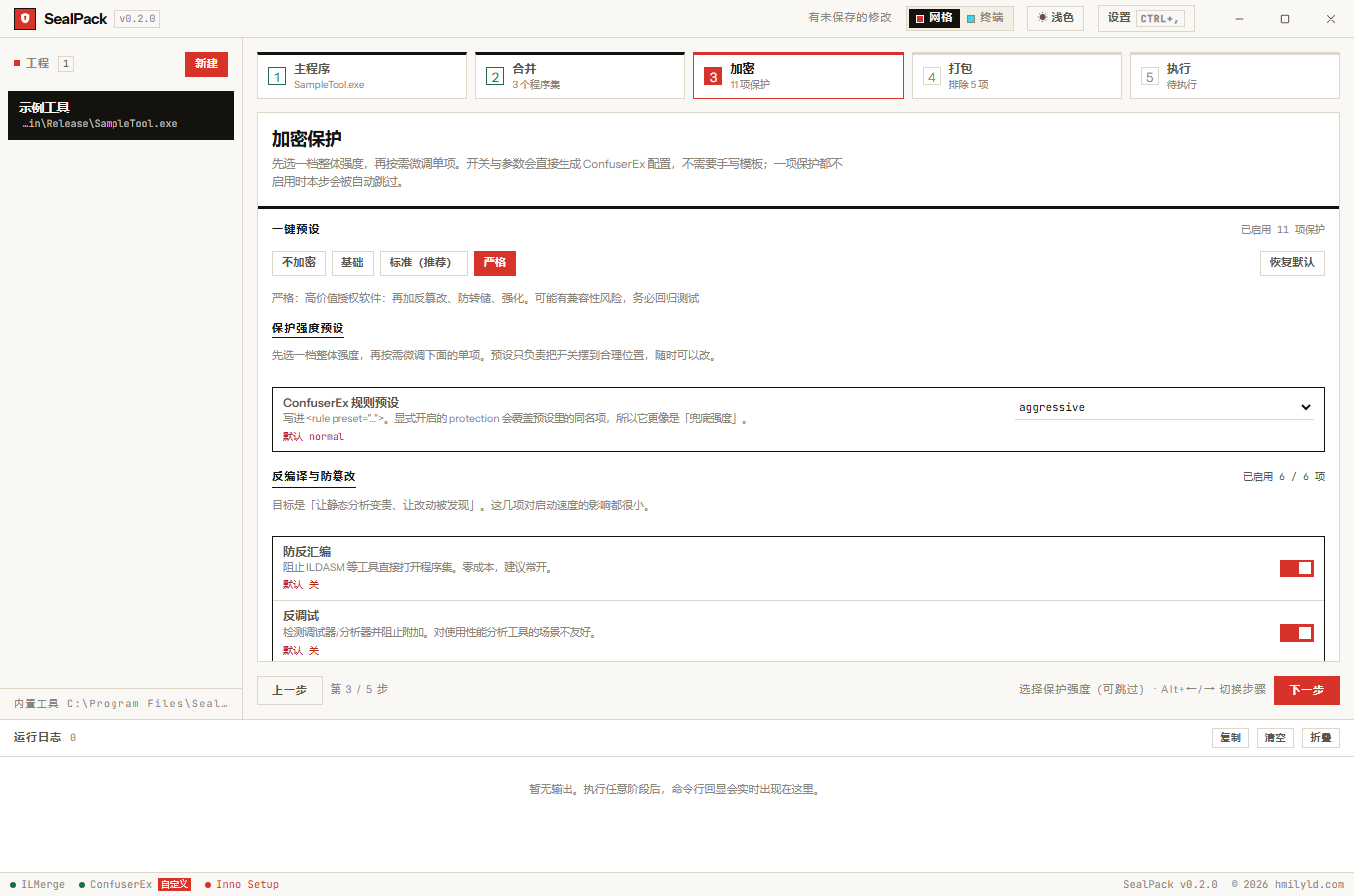
Protections inside <rule> are emitted in a fixed order (model.rs::enabled_protections). The UI summary
uses the same order, so reading them side by side never goes out of step:
anti ildasm → anti debug → anti dump → anti tamper → constants
→ ctrl flow → invalid metadata → rename → harden → ref proxy → resources
Protections with parameters emit <argument> elements, and values are written explicitly even when they
equal ConfuserEx’s own default — the tool’s position is that the UI switches are the single source of
truth, and the template should show what each switch produced:
| Protection | Arguments |
|---|---|
anti debug |
mode |
anti tamper |
mode, key |
constants |
mode, elements, cfg |
ctrl flow |
type, predicate (switch only), depth (expression/x86 only), intensity, junk |
rename |
mode, password (reversible only, when set), renameArgs, renEnum, renPublic |
ref proxy |
mode, internal |
resources |
mode |
| everything else | no arguments; self-closing <protection id="…" /> |
<module> carries path and optional snKey / snKeyPass; <project> carries outputDir / baseDir
and optional seed / debug; <packer id="compressor" /> appears when compress is on.
Two implementations, one fixture
The browser preview has no Rust, so preview/render.ts mirrors defaults.rs. Once they drift, the
template shown in the preview is not the template users get — and drift looks plausible in a preview; it
only surfaces on a real machine.
pnpm run check:render-parity compares the Rust dump against the TypeScript output character by
character. The fixture (docs/fixtures/render-fixtures.json, 22 cases) is committed, so the second
command runs without Rust installed.